Users
Start with TalkToAI, ZeroThink, OpenZero, API keys, PDFs, DNA Lab, and model limits.
Questions and answers
Use this as the plain-English reference for users, reviewers, researchers, operators, and builders.
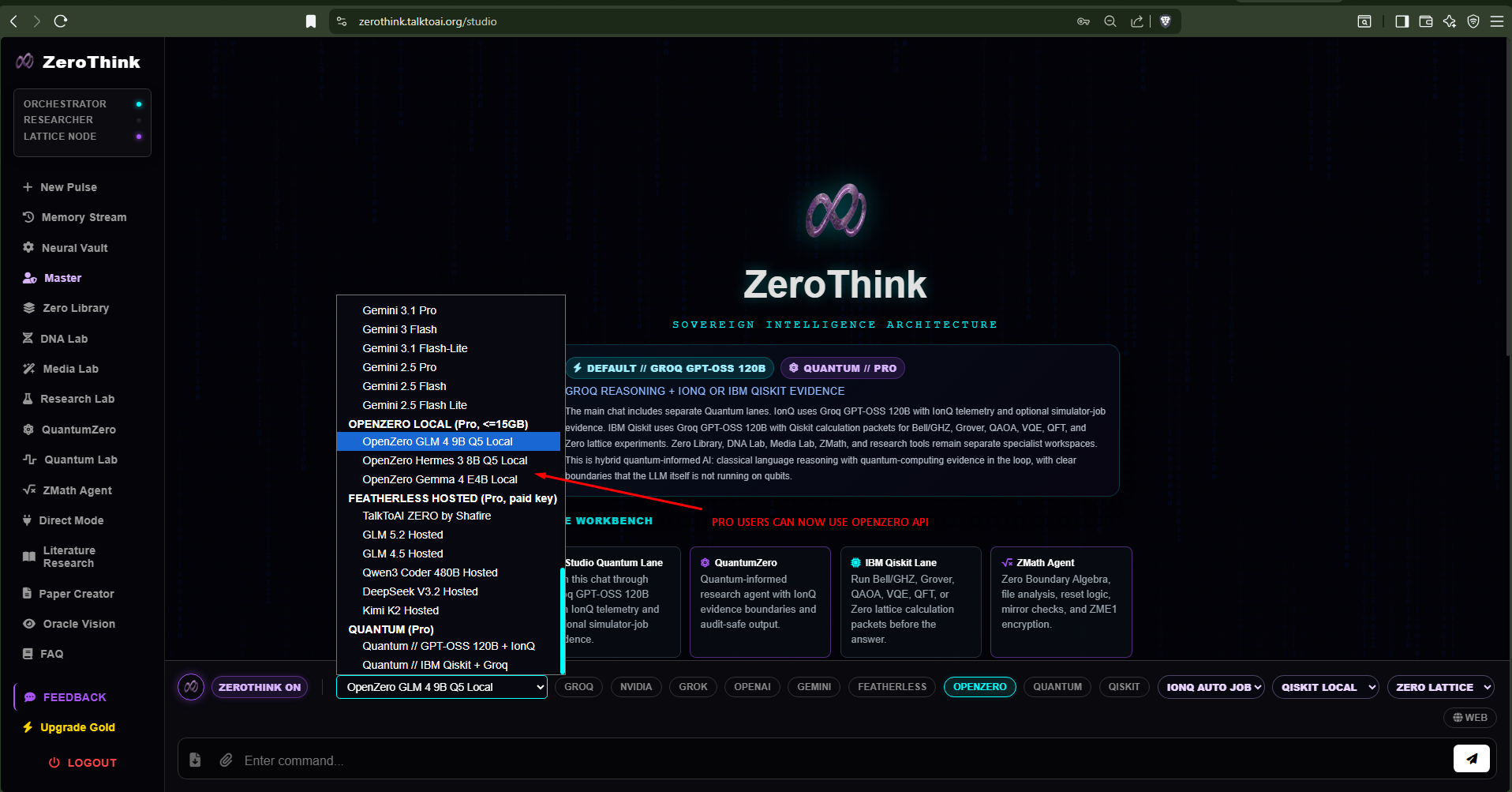
Start with TalkToAI, ZeroThink, OpenZero, API keys, PDFs, DNA Lab, and model limits.
Focus on UKRI, provenance-aware workflows, Research Paper Creator, literature workspaces, and evidence boundaries.
Read the OpenZero, ZSEC, backups, and public/private boundary answers before server work.
Use the course, UKRI page, GitHub shelf, video library, and site showcase as public proof points.
TalkToAI is the public ecosystem connecting ZeroThink, OpenZero, ZSEC, DNA Lab, UKRI briefing material, research workflows, GitHub projects, videos, Hugging Face model work, and service projects.
OpenZero is the free sovereign network and self-hosted AI node path. Users can install their own node and bring its API key into ZeroThink where supported.
Pro is for heavier routes such as advanced providers, Quantum lanes, hosted model access, OpenZero bridge trials, and higher-limit workflows where configured.
No. Featherless is a hosted model provider and generally requires a paid or bring-your-own Featherless API key.
For current OpenZero target machines, local model files should stay under 15 GB. Use hosted providers for larger models.
No. DNA Lab is research and education support. Health output is not diagnosis, treatment advice, or a replacement for qualified clinical review.
Yes. Users can request data deletion or review through the privacy/contact route. Identity verification may be required, and limited records may be retained where security, billing, legal, or account-support duties require it.
No. It is a non-confidential public briefing and scoping route. It does not imply a formal relationship unless one is completed and verified.
The July 2026 update made the newest OpenZero and ZeroThink capabilities easier to find: OpenZero's Z-Spark draft-verify lane, Voicebox option, CPU runtime controls, expanded Super Panel direction, ZeroThink/OpenZero bridge guidance, public-safe release notes, and cleaner docs/manual routes.
Use the Updates page at docs.talktoai.org/updates/ for the public changelog, then open the ZeroThink, OpenZero, and manual pages for user instructions.
Z-Spark is OpenZero's custom CPU-first draft-verify layer inspired by draft/verify speculative-decoding patterns. A small local model drafts, OpenZero checks confidence, and the active model verifies or rewrites. It falls back safely when the draft model is not available.
No. Z-Spark is custom OpenZero runtime logic. It does not claim to ship official DeepSeek DSpark checkpoints or private target-model internals.
Voicebox is an optional local voice backend. OpenZero keeps lightweight local speech fallback behavior and can connect to Voicebox when the user installs and runs it separately.
It is a free 14-module ecosystem course that explains ZeroThink, OpenZero, ZeroThink CLI, TalkToAI model work, ZMath, ZSEC, DNA Lab, FreeWebPanel, QuantumEncryption1, and public proof projects.
No. The live course stores progress in the browser and can generate a local completion certificate without a login.
The optional exam has 22 questions and produces a local browser certificate when completed.
No. It is a TalkToAI course completion record, not a university award, government endorsement, professional licence, or formal accreditation.
It gives UK research and innovation stakeholders a non-confidential overview of ZeroThink, provenance-aware AI workflows, protected scoping, quantum-readiness, and practical review routes.
No. It is a public briefing and scoping route only unless a formal relationship is completed and verified.
Start with ZeroThink, the Research Paper Creator, the course, the GitHub shelf, the UKRI briefing, OpenZero, ZSEC, and the public video library.
ZeroThink Studio is the web workbench for prompts, model/provider routing, Neural Vault keys, PDFs, research workflows, QuantumZero, ZMath, DNA links, and CLI handoff.
Yes. Users can ask for a PDF report or use the PDF Creator route. Strong prompts should include topic, audience, sections, evidence needs, and limitations.
Search-backed routes should use configured providers, preserve source titles, URLs, snippets, dates, and separate evidence from interpretation.
Neural Vault is the account-bound place for provider keys such as Groq, OpenAI, Gemini, xAI, NVIDIA, Serper, Featherless, IonQ, IBM Quantum, ZeroThink API, and OpenZero node keys.
The intended Vault UX supports add, remove, rotate, redacted display, and immediate revocation for user-owned keys.
It is a server-issued key for approved app/API integrations, managed through admin/master controls and scoped to accounts or usage policies.
It is a user-owned key created by an OpenZero machine or server so ZeroThink can connect to that local/self-hosted node where the bridge is enabled.
Shared TalkToAI resources should be a short premium trial. Sustained use should move users to their own OpenZero node to protect platform capacity and improve user ownership.
Current OpenZero target machines should not install local LLM files over 15 GB. Use smaller quantized GGUF models locally or hosted providers for larger models.
Use Q5 or Q6 when hardware permits, Q4 as a practical default, and Q3 when memory is tight. Always check total file size and RAM/VRAM.
GLM refers to GLM-family model routes useful for Chinese/English reasoning. Use hosted access if the model is too large for OpenZero hardware.
talktoaiZERO is a Shafire/custom model direction tied to the broader Agent Zero and TalkToAI model work. Hosted access is preferred when the file exceeds local limits.
Featherless is a hosted provider and should be presented as paid or bring-your-own-key unless the provider account says otherwise.
No. It is classical LLM reasoning over quantum-cloud, IonQ, IBM Quantum, or Qiskit evidence/context where configured. The boundary should stay explicit.
ZSEC Auto Updates is an open-source Linux security-only updater and hardening helper with no remote command channel.
No. ZSEC supports update discipline, but backups, monitoring, firewall rules, SSH key hygiene, and incident response remain required.
DNA Lab turns supported raw DNA files into research reports with health-research cards, heritage signals, lineage clues, maps, sound, PDF export, and private follow-up.
No. DNA Lab is research and education support. It is not diagnosis, treatment advice, or genetic counselling.
It is a staged workflow for scope, search protocol, source ledger, claim map, outline, draft, critique, revision, and export.
The showcase page promotes the real public proof network: TalkToAI, ZeroThink, OpenZero, ZSEC, DNA, FreeWebPanel, QuantumEncryption1, World SEO Service, Secure Hosting, Cymatics, FrontDeskAgent, and Shafire models.
The GitHub page promotes curated ResearchForumOnline project repos such as AgentZERO, FreeWebPanel, ZSEC, ZERO, ZT, WordPress AI chatbot, genetic adaptation, quantum bypass, and DNA encoding.
The docs focus on created, edited, pinned, or live-site-linked project repos, not random upstream mirrors or unrelated old forks.
Never publish API keys, OAuth secrets, SSH keys, passwords, cookies, database URLs, private server paths, runtime logs, backups, customer data, or private intellectual property.
Inspect first, back up, make scoped changes, test config, reload only after tests pass, and keep rollback paths.
The videos page embeds non-music TalkToAI content for TalkToAI, ZeroThink, research workflows, ZSEC, FreeWebPanel, hosting/security context, and older Zero concept videos.
Use the contact form for AI workflows, research reports, hosting, security, SEO, and product scoping. No login, signup, or public email address is needed on this docs page.